
Beyond the Soil Test: Why Outcomes Matter More Than Metrics

Updated: Aug 24
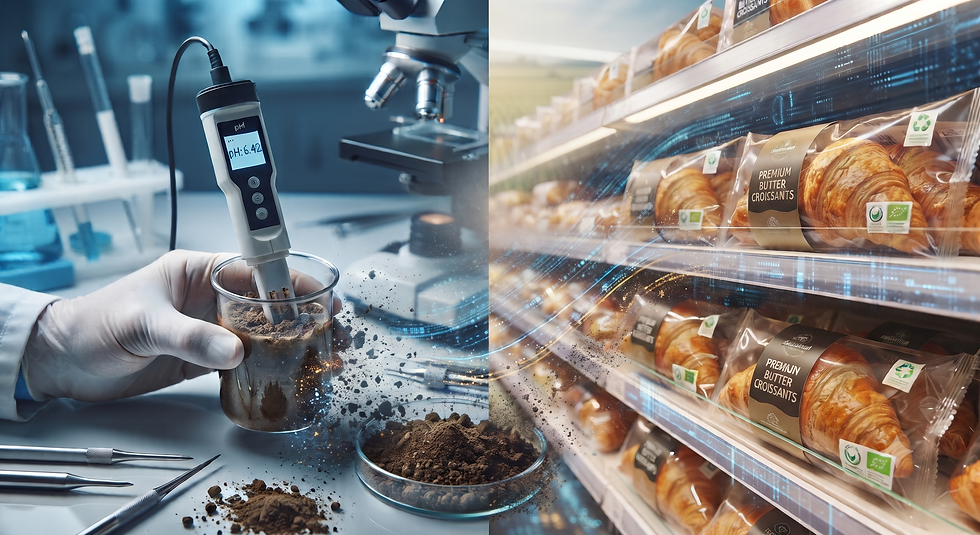
We Measure pH, But We Deliver Lower Carbon: Shifting the Focus from Agronomic Inputs to Commercial Outcomes
Modern agriculture has an obsession with measurement. Every season, farms and agribusinesses are inundated with an avalanche of technical metrics: soil pH, electrical conductivity, N-P-K nutrient ratios, and growing degree days. While these data points are critical for managing operations on the ground, they harbor a dangerous trap for enterprise leadership.
If you talk to a corporate buyer, a food processor, or a supermarket category manager about your soil’s optimal cation exchange capacity, their eyes will glaze over. They don't buy soil profiles; they buy finished goods. They buy consistency, compliance, and consumer trust.
The central challenge for modern ag-tech is bridging this language barrier. To scale successfully, businesses must stop treating agronomic metrics as the final destination and start treating them as the underlying machinery that powers commercial outcomes.
"Nobody ever bought a croissant because of the soil pH; they bought it because of the flake, the price, and the carbon footprint behind it."
The Disconnect Between the Field and the Boardroom
For decades, technology providers have pitched software by promising more data collection. Sensors get deeper, satellites get sharper, and spreadsheets get wider. Yet, executives often find themselves asking a blunt question: "How does this actually impact our bottom line?"
When technical teams speak exclusively in agronomic jargon while business development speaks in profit margins, a severe disconnect occurs:
The Relevance Gap: Supermarket consumers do not care about the soil pH of the plot where their breakfast pastry was grown; they care about the flake, the price, and whether the product meets sustainability targets.
The Noise Trap: Drowning in granular soil data without a clear commercial translation leads to analysis paralysis, where teams optimize for metrics that have little bearing on customer willingness-to-pay.
The Value Misalignment: If your software only proves that you can track dirt, you are selling an administrative tool. If your software proves you can reduce kilograms of CO2e per six-pack of croissants, you are selling enterprise value.
The Outcome-Driven Model
Shifting to an outcome-driven model requires a fundamental inversion of how we think about data. Instead of starting with what we measure in the field, we must start with what the market demands.
When you unify disparate field metrics into a single, cohesive system—such as the infrastructure provided by ascoreia from Adopt—the dynamic changes completely: complex environmental data is processed into standardized scores that both agronomists and executives can interpret instantly.
This transition unfolds across three key mechanisms:
Backward Integration: You identify what the end-user or industrial buyer requires—such as exact protein content, strict carbon limits, or specific sizing—and work backward to determine which field metrics actually drive those outcomes.
Commercial Translation: Raw environmental variables are automatically translated into business intelligence, allowing account managers to prove quality and sustainability to clients with mathematical certainty.
Unified Accountability: Agronomists and executives finally share a common language. Field teams understand that their hard work in the dirt directly correlates with corporate sales and brand differentiation.
Redefining Success
Nobody ever bought a croissant because of the soil pH; they bought it because of the flake, the price, and the carbon footprint behind it.
By shifting your organizational focus from collecting metrics for metrics' sake to delivering verified commercial outcomes, you turn your technical complexity into your greatest market advantage. When your data speaks the language of the balance sheet, the entire enterprise wins.


Comments