
Translating Agronomics into Enterprise Value

Updated: Aug 24
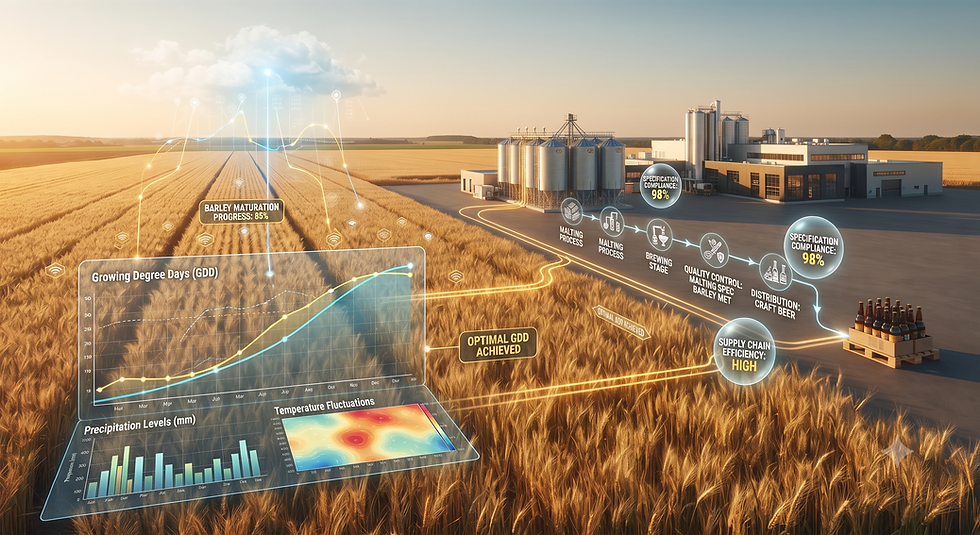
From Growing Degree Days to Malting Spec Barley: How Data Translation Drives Profitability
In the world of large-scale agricultural production, tracking environmental inputs is standard practice. Meteorologists and farm managers track growing degree days, soil moisture levels, and thermal units religiously. These variables dictate when crops are planted, sprayed, and harvested.
However, knowing that your crop experienced 2,100 growing degree days doesn't automatically put money in the bank. For B2B suppliers dealing with industrial buyers—such as commercial breweries or food conglomerates—the metric that matters is not the weather; it is the specification.
The true differentiator for modern agribusinesses is the ability to translate raw environmental data directly into commercial grade specifications that protect margins and secure long-term contracts.
"Agronomic data tells you what happened in the dirt; commercial translation tells you what it's worth on the balance sheet."
The Cost of Raw Data Without Context
Raw agronomic data is inherently passive. It tells you what happened in the dirt, but it does not tell you what it is worth on the balance sheet.
When businesses rely solely on tracking intermediate field metrics without linking them to final commercial outcomes, several vulnerabilities emerge:
Spec Rejection Risk: A crop can be grown with perfect agronomic adherence, but if weather anomalies shift the final kernel composition or moisture content outside of industrial tolerance levels, the entire batch can be downgraded or rejected at delivery.
Missed Premium Pricing: Industrial buyers pay top dollar for guaranteed specifications (such as low-protein malting barley or specific milling tolerances). Without predictive translation models, you miss out on capturing these lucrative market premiums.
Negotiation Disadvantage: When pitching to enterprise partners, vague assurances of "good farming practices" hold little weight compared to verifiable, data-backed proof of end-product quality.
Bridging the Gap Through Intelligent Translation
Transforming raw meteorological and soil inputs into high-value commercial outcomes requires a sophisticated analytical bridge. Systems like ascoreia from Adopt integrate field-level data directly with industrial specification requirements, allowing operators to manage crops with the end-market in mind from day one.
This translation process changes how contracts are managed:
Inherent Predictive Grading: Taking a long term analytics approach which provides consistent estimate of the inherent capacity of the field to provide the outcome that you are looking for. It offers a stable and highly predictable model for establishing value. The 5 year growing degree days, takes into account the variations that a single crop cycle may experience.
Targeted Adjustments: Field locations can be adapted to allow for mutli year crop rotation modeling that can optimise harvest outcomes to meet your operational business objectives
Verifiable B2B Transparency: The large scale analytics and the multiyear modeling and Provides industrial buyers with automated, immutable proof that contracted specifications have a higher potential for being acheived, builds deep trust and locks in long-term supply agreements.
Turning Weather Into Wealth
Agronomic data tells you what happened in the dirt; commercial translation tells you what it's worth on the balance sheet.
By mastering the transition from environmental inputs to industrial specifications, agribusinesses transform themselves from commodity producers into precision suppliers. When you can guarantee precise outcomes rather than just good intentions, you secure your pricing power and future-proof your commercial relationships.


Comments